Pitch Raise vs. Standard Tuning: What an Old Upright Usually Needs
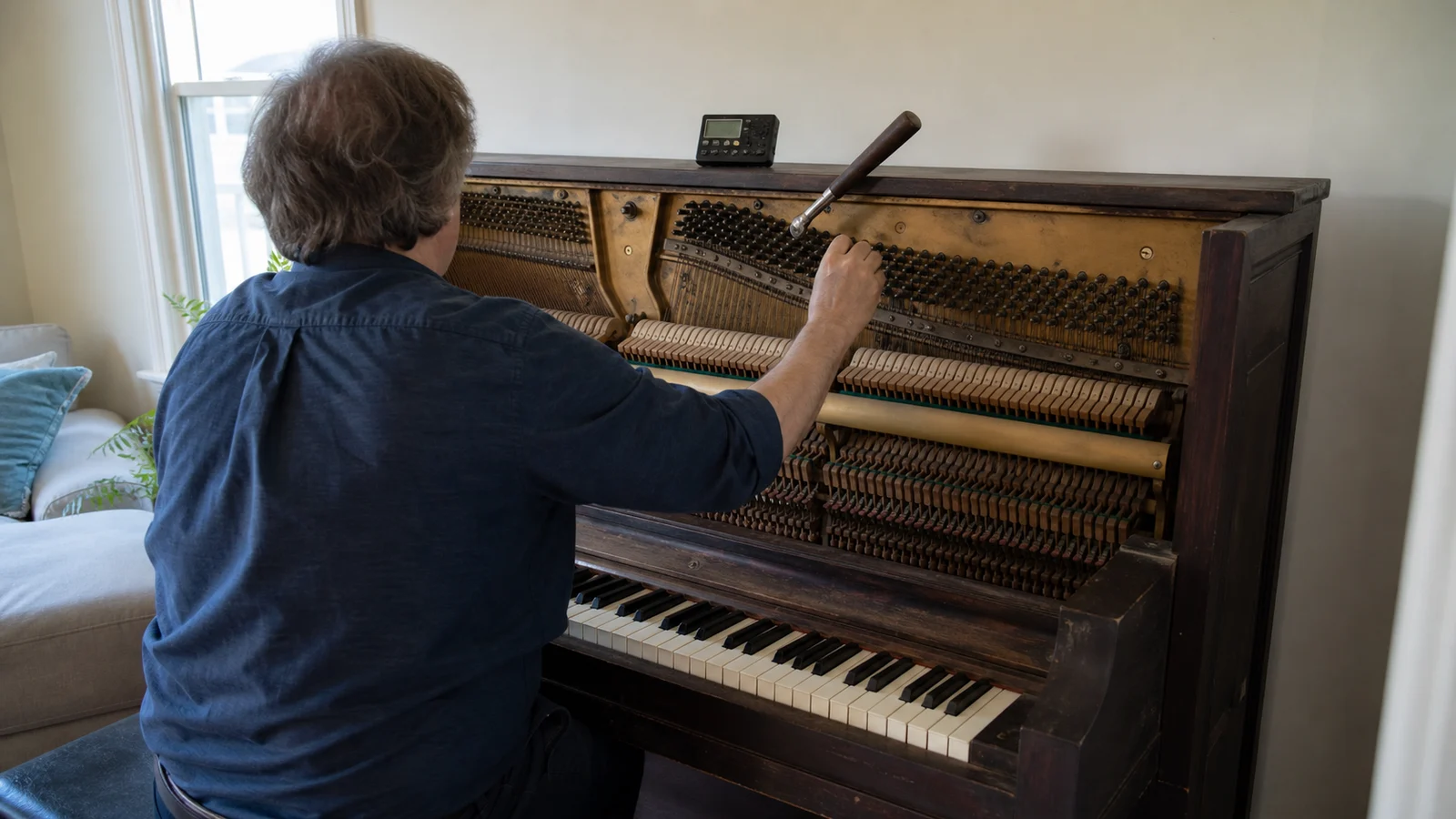
A Piano Inside tuning guide explaining when an old upright needs pitch correction, A440 stabilization, follow-up tuning, and room humidity control.
When an older upright has gone several years without service, I do not assume that a standard tuning is the correct first step. I begin by measuring the piano's present pitch, listening for unstable strings, and checking whether the instrument can safely and reasonably be brought closer to the modern reference of A440. Sometimes the piano is only slightly low and a normal tuning is appropriate. Sometimes the entire instrument has drifted far enough that a controlled pitch correction is needed before fine tuning.
Owners often hear the words pitch raise and imagine a repair or an optional upgrade. It is better understood as a tuning procedure. The first pass changes the overall string tension toward the target pitch. The fine-tuning pass then corrects the relationships between notes and strings with greater precision.
Why an old upright can fall below pitch
An acoustic piano carries substantial combined string tension. Seasonal humidity changes, long periods without tuning, moves between rooms, and normal settling can gradually lower pitch. Toronto winters can be especially dry indoors, while summer humidity can move the soundboard in the opposite direction. The change is not always uniform, but neglected pianos often show a broad drop across much of the keyboard.
Being below A440 does not by itself prove that a piano is damaged. The amount of deviation, the condition of the strings and tuning pins, and the owner's intended use all matter. My first responsibility is to assess the instrument rather than force it into a predetermined procedure.
What makes a pitch raise different
A piano is a connected system. Raising hundreds of string segments changes tension while the appointment is still in progress. Notes tuned early can move as later sections are brought upward. If I tried to perform only a delicate final tuning from the beginning, much of that work could be displaced before I reached the top of the keyboard.
During pitch correction, the goal is controlled compensation. I bring sections toward the target while anticipating some movement, then return for the finer pass. The exact method depends on how low and uneven the piano is. It is not simply a matter of turning every tuning pin farther.
What I check before raising pitch
I inspect tuning pin stability, string condition, obvious corrosion, bridge and soundboard clues, and the general response of the piano. I listen for false beats, weak bass strings, and strings that do not respond normally to small adjustments. I also ask about recent moves, storage, heating, and humidity because those details help explain the present condition.
Very old or fragile instruments require judgment. A broken or heavily corroded string, loose tuning pins, structural concerns, or an owner who only needs limited casual use may change the plan. In some cases, a conservative pitch target or repair discussion is more honest than promising A440 immediately.
Standard tuning after the correction pass
Once the broad pitch level is closer to the target, I can concentrate on stable unisons, octaves, intervals, and the overall temperament. This is the part most owners recognize as tuning. The result is more useful because the piano is no longer moving as dramatically from a large tension change during the same pass.
A pitch raise and fine tuning may be completed during one visit when the instrument responds well. That does not mean the piano will never move afterward. An instrument that was far below pitch may settle again as tension and room conditions stabilize. I explain that possibility before beginning so a follow-up recommendation does not come as a surprise.
When a follow-up tuning is sensible
The farther the pitch correction, the more reasonable it is to reassess the piano after it has been played and allowed to settle. Follow-up timing depends on the amount of correction, room stability, season, and how the piano responds. There is no honest universal promise that every neglected upright will become completely stable in a single appointment.
After a move, I also consider whether the new room is still changing. A piano placed beside a heating vent, exterior door, or strong humidity source can drift even after careful service. Stabilizing the environment helps the tuning last and protects action parts, bridges, and the soundboard.
What the owner should expect
Before the appointment, it helps to share when the piano was last tuned, whether it has been moved, and whether any strings or notes are already causing concern. During the visit, I can measure the pitch and explain whether the work looks like a standard tuning, a pitch correction plus tuning, or a condition assessment that should come first.
The practical goal is not to attach a dramatic label to an old piano. It is to choose the sequence that produces the most stable and musically useful result without pretending that age, neglect, or room conditions do not matter. When a pitch raise is recommended, it is usually because the instrument needs a controlled first step before detailed tuning can hold together.
← Back to Learning Center