Seating the Strings: The Technician's Secret to Ultimate Tuning Stability
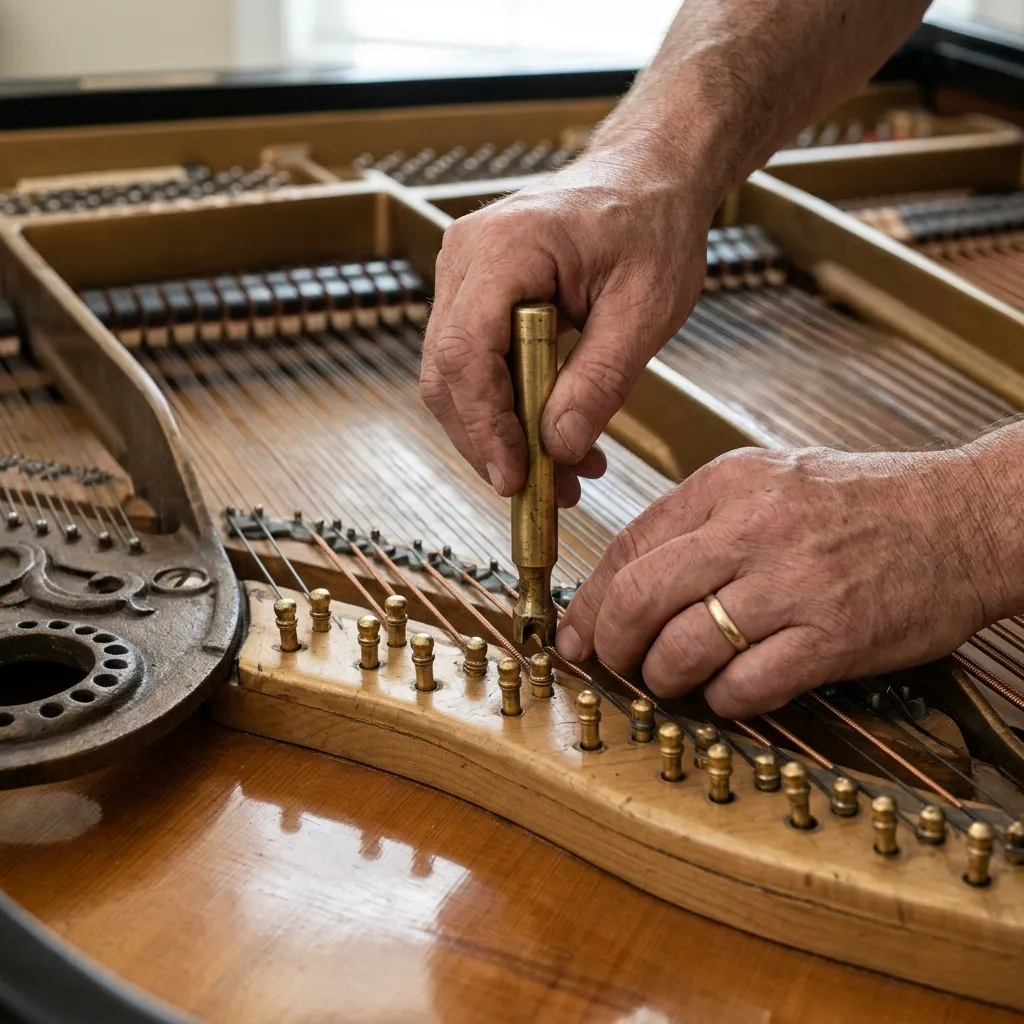
Have you ever had your piano tuned, only to find it drifting out of tune just a few days later? While radical humidity changes in Toronto are often the primary culprit, there is another, more mechanical reason why a tuning might not hold. It all comes down to a crucial, yet often overlooked, procedure performed by master technicians: seating the strings.
The Path of the Piano String
To understand why string seating matters, we first need to look at the anatomy of a piano string. A string does not travel in a straight, unimpeded line from the tuning pin to the hitch pin. Instead, it must weave through and bend around several critical pressure points:
- The V-Bar or Agraffes: These metal components determine the exact speaking length of the string at the front of the piano.
- The Bridge Pins: The string zig-zags through two metal pins embedded in the wooden bridge, which transfers the string's vibrational energy to the soundboard.
Because piano wire is made of stiff, high-carbon steel, it does not naturally bend perfectly around these sharp angles. Instead, it forms a subtle, microscopic curve at every bend. This creates friction and uneven tension across the different segments of the string.
The Danger of "False Tension"
When a technician turns the tuning pin, the tension changes at the pin block first. Because the string is caught on the friction points (agraffes, bridge pins), the tension change doesn't distribute evenly across the entire length of the string right away. This creates "false tension."
If the technician leaves the string in this state, the very first time the pianist plays a heavy fortissimo chord, the violent vibration of the hammer striking the string will overcome the friction at the bridge pins. The string will suddenly slip, the tension will equalize, and the note will instantly drop out of tune.
How Technicians Seat the Strings
To combat this, master piano technicians employ a proactive technique. Using a specialized brass or hardwood seating tool, the technician physically taps or firmly presses the strings down against the bridge and the bridge pins.
This forceful action accomplishes two things:
- It forces the stiff steel wire to bend sharply and conform perfectly to the bridge pins, eliminating any microscopic gaps.
- It instantly equalizes the tension across the entire speaking and non-speaking lengths of the string, completely removing any "false tension."
The Result: Rock-Solid Stability
Master tuners often prefer a moderate approach to "test blows" (striking the key hard while tuning) when they know they have meticulously seated the strings at all pressure points. Once a string is properly seated, the piano achieves an incredible level of mechanical stability. Assuming the room's humidity remains constant, a properly seated tuning will lock in place and survive even the most aggressive playing styles.
If you're looking for a tuning that truly lasts, don't just ask for a quick pitch adjustment. At Piano Inside, our certified technicians take the time to ensure every mechanical component, from string seating to action regulation, is optimized for maximum stability and tonal brilliance.